
Students Explore the Night Sky: The University of Bayreuth Observatory Opens
After nearly a year of construction, the commissioning of the telescope and scientific equipment, an extensive testing phase, and most recently the creation of tutorials for the observatory’s remote operation, the moment has finally arrived: The University of Bayreuth observatory is officially opening.
Opening of the University of Bayreuth Observatory with a Public Tour
Wednesday, 16 September, 12:30 p.m.
Meeting point: Main entrance to the Ecological Botanical Garden of the University of Bayreuth (ÖBG)
(From there, we will walk together to the observatory, located in southern end of the garden)
The opening will take place as part of a public tour, during which attendees will learn about the observatory’s construction, equipment, and, of course, its potential uses. In addition, the first two students will be on hand to share their initial experiences with the observatory and how to operate it.
When weather conditions permit, visitors also have the opportunity to observe the sun live through the observatory's instruments.
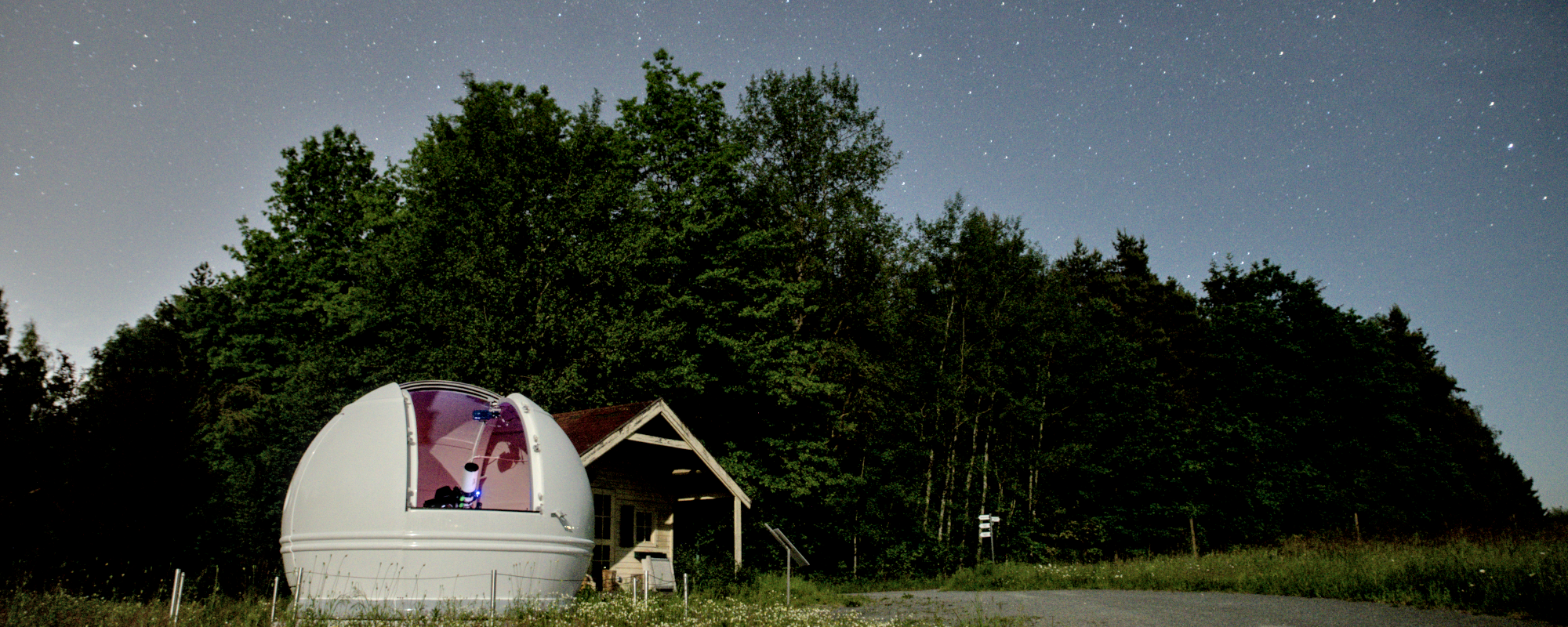
The University of Bayreuth Observatory, located on the southern grounds of the Ecological-Botanical Garden. - © Dr. Thorsten Schumacher, Universität Bayreuth
At the heart of the observatory is a fully automated telescope equipped with a color-corrected wide-field apochromatic lens and a precise, computer-controlled mount. The telescope can be combined with various cooled camera sensors as well as a broadband or high-resolution spectrometer. This allows for the observation, digital recording, and analysis of a variety of astronomical phenomena. The observatory is operated entirely remotely, allowing students to conduct observations from home regardless of the season or outside temperature.
In addition to its use in lectures and a new project-based lab in the Introductory Physics Lab, the observatory is also intended for use in the Advanced Physics Lab. Furthermore, students can develop and carry out their own research ideas as part of an astronomy club. The flexible combination of instruments and detectors enables a wide range of projects, from the study of binary star systems to the analysis of planetary atmospheres and the detection of exoplanet transits. The focus is always on independently planning and conducting the measurements, as well as the subsequent digital processing and physical analysis of the data.
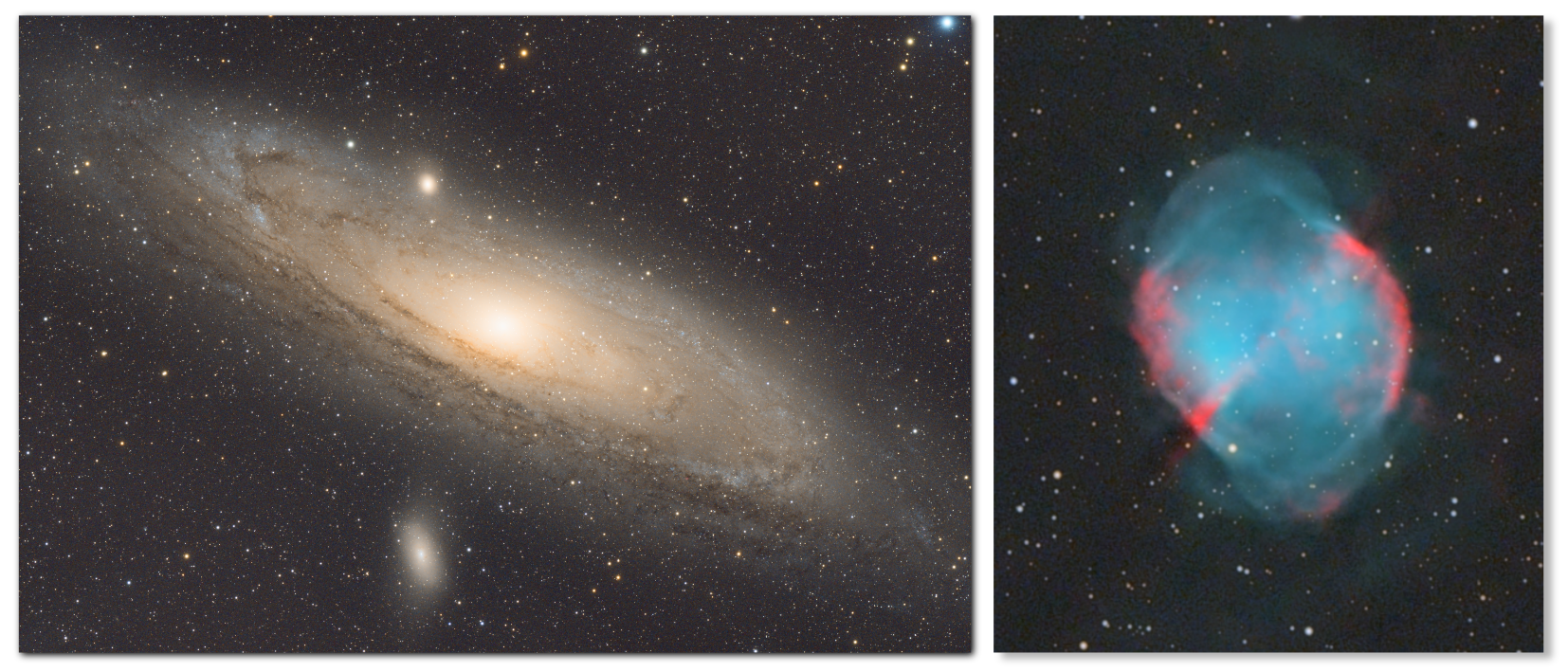
The Andromeda Galaxy (left) in our galactic neighborhood, and the Dumbbell Nebula (right), a planetary nebula showing the end of a sun-like star. Both images were taken by the University of Bayreuth Observatory. - © Dr. Thorsten Schumacher, Universität Bayreuth
Dr. Thorsten Schumacher, director of the observatory, is looking forward to future projects and encourages students to join the astronomy club to try out their own research ideas: “With the observatory, we offer students the opportunity to conduct independent research in a fascinating field. The observatory has recently become fully operational, and the first students have already begun working with it. I’m excited to see what projects the students will carry out using the observatory and what new ideas will emerge from them.” The project was supported by funds from student grants and carried out in close and grateful collaboration with the Ecological Botanical Garden, as well as with the cooperation of the Building Department, Central Engineering, the Workshops, and the IT Service Center.
Further information about the University of Bayreuth Observatory
https://www.physik.uni-bayreuth.de/observatory
Dr. Thorsten Schumacher
Directory of the University of Bayreuth Observatory
University of Bayreuth
Chair of Experimantal Physics III
e-mail: thorsten.schumacher@uni-bayreuth.de